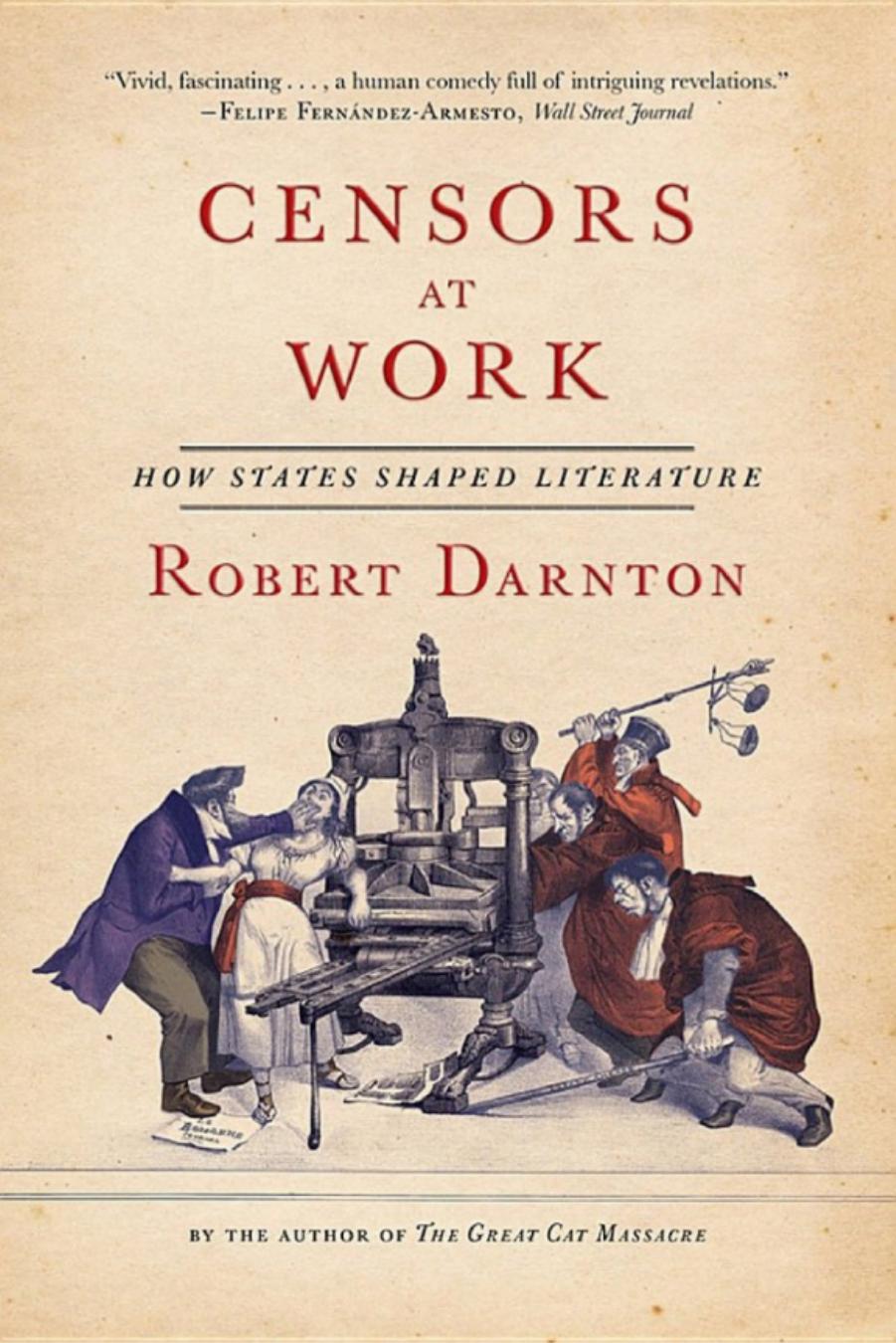
Censors at Work: How States Shaped Literature by Robert Darnton
Author:Robert Darnton [Darnton, Robert]
Language: eng
Format: azw3, pdf
Publisher: W. W. Norton & Company
Published: 2014-09-22T04:00:00+00:00
AUTHOR-EDITOR NEGOTIATIONS
The memos that circulated at the highest levels of the GDR showed that censorship was not limited to the activities of the censors. It penetrated every aspect of literature, down to the innermost thoughts of the authors and their first contact with editors. Volker Braun defined its character in a note that he scribbled for himself while struggling to get a draft of his Hinze-Kunze-Roman past an editor at the Mitteldeutscher Verlag (MDV) in 1983: “The system works all by itself. The system censors.”57 This systemic penetration was deepest at the lowest level, where authors and editors negotiated over the planning and production of manuscripts. Although practices varied, they normally went through the same stages. As described earlier, the idea for a book might germinate in the mind of an author, but it frequently originated among the editors of the GDR’s seventy-eight publishing houses or even among the censors and other officials in Berlin. Because the director (Verlagsleiter) and chief editor (Cheflektor) of the houses were important Party members—powerful apparatchiks or nomenklatura—they exercised great ideological control. Yet lower-placed editors often developed friendly relations with authors, who usually worked with the same house—notably, in the case of contemporary fiction, the Mitteldeutscher Verlag (MDV) in Halle and Leipzig and the Aufbau Verlag in Berlin and Weimar.58 Instead of writing on their own until they had arrived at a finished manuscript, the authors usually sent the editors early drafts and small segments. The editors responded with suggestions for changes, and a process of negotiation continued until both sides reached agreement about a final draft. At that point, the editor sent the typescript to one or more outside readers, who tended to be trusted advisers, often literary critics and academics. The readers’ reports could trigger more rounds of negotiation and changes. When a reworked text had been completed, the publisher prepared a dossier, which included the readers’ reports and a publisher’s report, usually four or five typewritten pages, by the chief editor, along with information about the author, the format, the amount of paper required, the proposed pressrun, and the price.
The dossier and the text then were sent to the HV office in Clara-Zetkin-Strasse for approval by the professional staff in the manner described by Hans-Jürgen Wesener and Christina Horn. The process of censoring could continue even after the book had been published, because if it provoked a scandal, it could be withdrawn from bookshops and pulped. Certain passages might be excised from later editions, but they also might be added; for the HV sometimes permitted a West German edition by giving clearance through the Copyright Office (Büro für Urheberrechte). To be sure, the Western edition might stir up controversy; but once the dust had settled, its controversial passages could be reprinted discreetly in a new GDR edition.
Censorship took place throughout the entire process—and even beyond it, because authors and publishers remained vulnerable to post-publication sanctions. Yet the most important part of the process is the most difficult to identify, because it happened in the author’s head.
Download
Censors at Work: How States Shaped Literature by Robert Darnton.pdf
This site does not store any files on its server. We only index and link to content provided by other sites. Please contact the content providers to delete copyright contents if any and email us, we'll remove relevant links or contents immediately.
| Anthropology | Archaeology |
| Philosophy | Politics & Government |
| Social Sciences | Sociology |
| Women's Studies |
The Secret History by Donna Tartt(19102)
The Social Justice Warrior Handbook by Lisa De Pasquale(12196)
Thirteen Reasons Why by Jay Asher(8917)
This Is How You Lose Her by Junot Diaz(6892)
Weapons of Math Destruction by Cathy O'Neil(6283)
Zero to One by Peter Thiel(5806)
Beartown by Fredrik Backman(5764)
The Myth of the Strong Leader by Archie Brown(5511)
The Fire Next Time by James Baldwin(5452)
How Democracies Die by Steven Levitsky & Daniel Ziblatt(5223)
Promise Me, Dad by Joe Biden(5156)
Stone's Rules by Roger Stone(5089)
A Higher Loyalty: Truth, Lies, and Leadership by James Comey(4965)
100 Deadly Skills by Clint Emerson(4929)
Rise and Kill First by Ronen Bergman(4796)
Secrecy World by Jake Bernstein(4755)
The David Icke Guide to the Global Conspiracy (and how to end it) by David Icke(4721)
The Farm by Tom Rob Smith(4516)
The Doomsday Machine by Daniel Ellsberg(4492)
